Forklifts
Battery vs Diesel Forklift: Which Is Better for Your Warehouse?
By Jonah Tan, Equipment Specialist · · 2 min read

Battery forklifts have become the default for many warehouses, but diesel still has its place. In the battery vs diesel forklift decision, the right choice depends on where the forklift works, how heavy the loads are and how many hours it runs each day.
The short answer
- Choose battery (electric) for indoor warehouses, food and clean environments, and operations that want lower daily running costs and less noise.
- Choose diesel for outdoor yards, heavy loads, long continuous shifts without charging access, and rougher (but still firm) surfaces.
Battery vs diesel forklift: side-by-side comparison
| Item | Battery (lithium-ion) | Diesel |
|---|---|---|
| Indoor use | Ideal: no exhaust, quiet | Not suitable for enclosed areas |
| Running cost | Lower: electricity is cheaper than fuel | Higher fuel cost |
| Maintenance | Fewer moving parts, no oil changes | Engine servicing, filters, oil |
| Refuelling | Charging; lithium-ion allows quick top-up charges at breaks | Refuel in minutes |
| Capacity range | Commonly 1.5 – 5 tonnes | Up to 16 tonnes and beyond |
| Outdoor / rain | Light outdoor use on firm ground | Built for outdoor yards |
Why lithium-ion changed the picture
Older lead-acid battery forklifts needed long charging times, watering and sometimes a spare battery. Lithium-ion forklifts, like the EP range we carry, can be opportunity charged during breaks without damaging the battery, need no watering, and keep steady power until the battery is low. For most single and double-shift warehouses this removes the main downside of electric.
Questions to ask yourself
- Where will it work? Mostly inside a building? Go electric.
- What is the heaviest load? Above 5 tonnes, diesel is usually the practical choice.
- How many hours a day? Long continuous shifts with no break for charging favour diesel.
- What is the ground like? Our forklifts use standard tyres and need firm, level ground. They are not designed for soft or rough sites; for those, look at a telehandler (see telehandler vs forklift).
- Is there power for charging? You will need a suitable power point where the forklift is parked.
Tip: if you are unsure, rent first. A short rental lets your team test a battery forklift in your real operation before you commit to buying.
What we carry
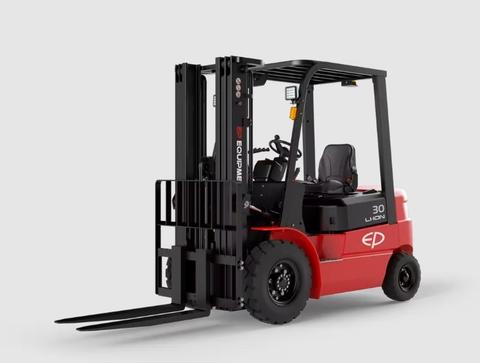
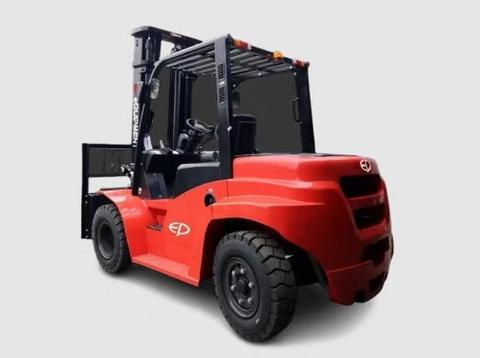
A&G Equipment is an authorised EP forklift distributor. We rent and sell EP lithium-ion battery forklifts from 1.5 to 5 tonnes and diesel forklifts from 1.5 to 16 tonnes, with servicing and parts handled in-house. Every forklift is serviced before delivery and comes with a valid PMA, with delivery to Johor, KL & Selangor. See our full forklift rental in Johor range, or forklift rental in Kuala Lumpur.
Our options: the EP 3.0/3.2 Ton Li-ion Forklift and the EP 3.0/3.5 Ton Li-ion Forklift for warehouses and factories, and the EP 7 Ton Diesel Forklift for heavy outdoor work.